
Pima County Arrest Warrants Explained
In Arizona, a judge or magistrate signs an arrest warrant only after reviewing a sworn statement and finding probable cause. The document names the person to be arrested. It then gives peace officers the authority to take that person into custody. A tip, an old case event, or an online name match is not the same thing. None of them alone shows a Pima County arrest warrant is active now. The court owns the judicial status. The Pima County Sheriff's Department, municipal police, constables, and sometimes federal officers serve warrants within their own authority, but their reports answer a different question: what the agency did. That split tells you where to confirm an order and where to ask later for arrest or transport material.
Probable Cause in Pima Courts
An officer's wish to arrest does not create a warrant. A Pima County judicial officer weighs the facts offered under oath. Then the officer decides whether the legal threshold is met. Access to the warrant order or its affidavit depends on the stage and record type. Search-warrant materials, for instance, can stay restricted under Arizona law while disclosure could harm an investigation.
Key point: A public docket can reveal a case event, but the issuing Pima County court must confirm the warrant's present force and terms.
An arrest warrant in Pima County starts a custody and court process. It does not decide the case. Initial appearance, release conditions, counsel, charging decisions, and later hearings each follow their own rules. Rely on the filed record and qualified legal advice rather than the existence of an order.
Arizona's Arrest Warrant Overview
The Arizona Judicial Branch warrant explainer lays out the state framework distinguishing arrest from bench warrants, including how Pima County courts apply it.
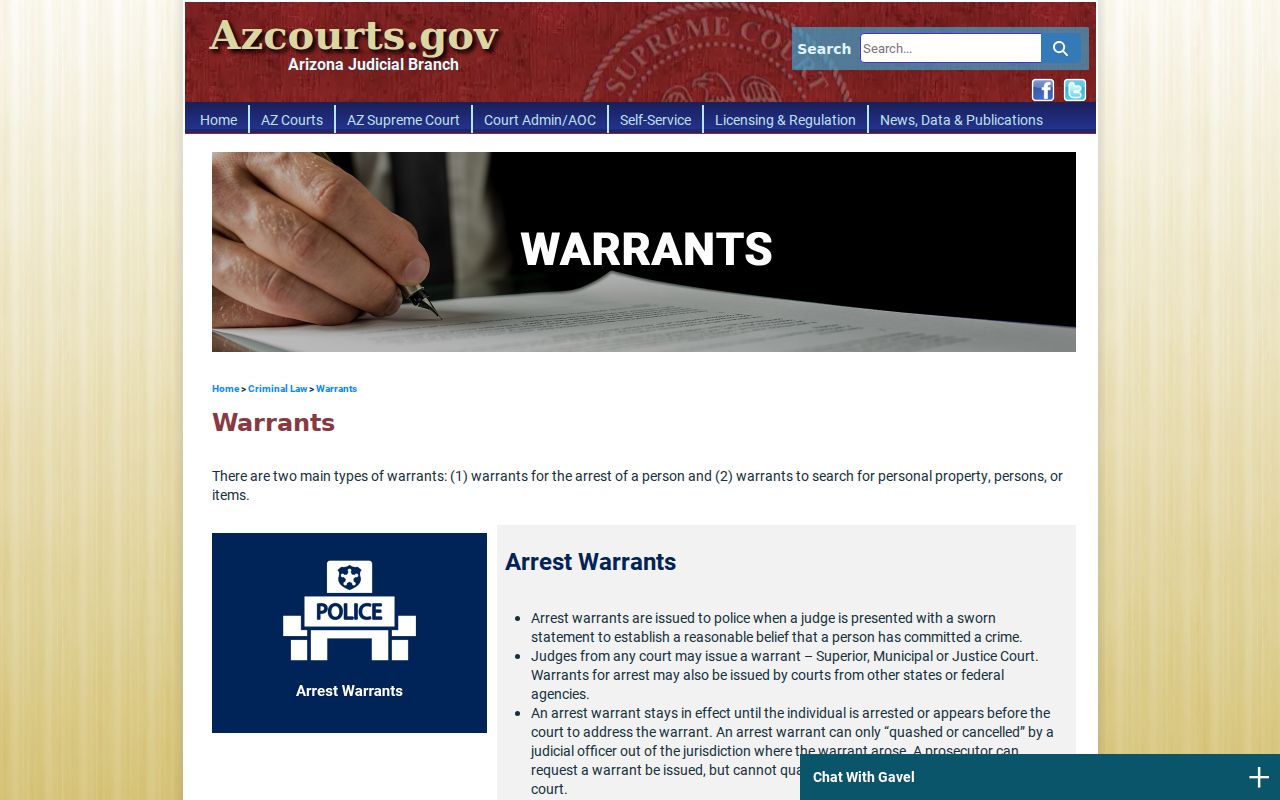
That overview gives statewide context. For a particular Pima County order and its current status, the issuing court remains the source.
Inside a Pima County Arrest Warrant
The exact public fields vary by court and by access rules. A Pima County court record may show the issuing court, case number, issue date, named subject, alleged offense or charge reference, and judicial terms. A law-enforcement return can document service. Sensitive identifiers, victim information, sealed material, juvenile information, or investigative detail may be missing or redacted.
| Issuing court | Controls status and judicial action |
|---|---|
| Case or warrant number | Helps the clerk locate the correct file |
| Issue information | Shows when the order entered the case |
| Charge reference | Connects the order to the alleged offense |
| Service or return | May show later law-enforcement action |
| Status change | Requires a later court entry or order |
A shared name is not a positive match. A full date of birth and case identifiers let a Pima County court tell records apart. Private identifiers should not be republished.
Arizona DPS Search Limits
The Arizona DPS Warrant Search offers a statewide lead. It is not a certified or complete Pima County result. DPS states its information is not real-time, current, active, or complete, and the tool returns no more than five results. Take any possible match to the issuing court listed in the result for confirmation. Arizona Judicial Branch Public Access adds a second path across participating courts. It is unofficial, excludes some case types and unavailable courts, and updates weekly. eAccess delivers eligible Superior Court documents through an account and paid access, with sealed and restricted materials excluded. These channels help locate a case. None replaces a live clerk check.
Use online results as routing clues, then ask the named Pima County clerk whether the arrest warrant remains active.
Serving Arrest Warrants in Pima County
The Pima County Sheriff's Department serves warrants and runs the Adult Detention Complex. City police handle matters within their municipal policing work, and constables serve process within their authority. Federal warrants belong to federal courts and agencies, even when the Tucson federal courthouse or a fugitive task force is involved. Jurisdiction and assignment shape who acts. Service can happen through direct contact with an officer, during another lawful encounter, or through an arranged surrender. No single office serves every Pima County warrant. So no office should be treated as the universal serving unit. Call the issuing court about judicial status. Ask the relevant agency about its own records or surrender logistics.
Sheriff Reports Are a Separate Record
The Pima Sheriff public-records form fits Sheriff-created incident reports, arrest reports, body-worn-camera media, 911 audio, photographs, and service or transport material. It is not a countywide arrest warrant lookup. The Sheriff's FAQ likewise does not replace the courts as the custodians of warrant status. A requester should give the incident or case number if known, plus date range, place, agency, and the precise record sought. The form asks about commercial or non-commercial purpose, delivery, and media. Posted copy, media, and labor charges may apply, and the Sheriff's page displayed a fee change effective October 4, 2026. Verify the schedule before ordering. Ongoing investigations, risks of harm, and victim information can restrict disclosure. If material is withheld, ask for the reason and any segregable public portion. An agency response with no report does not prove that no court warrant exists in Pima County.
Comparing Arrest, Summons, and Bench Warrants
These orders can all appear in a Pima County criminal case file. They don't carry equal authority. How each one arises shapes what you ask the clerk and whether you need a lawyer right away.
| Process | Starting point | Usual effect |
|---|---|---|
| Arrest warrant | Probable-cause finding | Authorizes custody |
| Summons | Court commands an appearance | Directs attendance without the same arrest command |
| Bench warrant | Missed setting or unmet duty in a case | Authorizes custody to return the matter to court |
Even in Pima County, a bench warrant can still end in an arrest. An arrest warrant stays open until police serve it or a judge acts. The label must come from the order. Search warrants sit in a separate category, since they authorize a search rather than the arrest process covered here.
When the Pima Court Is Unknown
Call 520-724-3310 first. Pima Pretrial Services runs a free countywide warrant check and can help identify the court. Superior Court takes 520-724-4200, and its Clerk uses 520-724-3200. The Consolidated Justice Court number is 520-724-3171. Ajo and Green Valley have separate contacts, and city matters may sit in Tucson, Marana, Oro Valley, Sahuarita, or South Tucson.
- Collect any citation, prior notice, case number, charge date, and court name already available.
- Use Pima Pretrial Services if the jurisdiction is unclear.
- Check Public Access or DPS only as a lead, using enough identifiers to reduce a false match.
- Call the listed clerk and ask about current warrant status and the next formal step.
- Request the official order or docket entry if a document is needed.
The Sheriff's main line is 520-351-4600. For Pima County, that number reaches the agency rather than a warrant lookup, and detention logistics use the Adult Detention Complex channel at 520-351-8282.
If There's an Arrest Warrant for You
Silence from a database proves nothing. Neither does an assumed payment clear a Pima County arrest warrant, so confirm the court, the case, the current status, and any judicial terms. A criminal-defense lawyer can pull the public record, explain exposure to custody and release conditions, and arrange an orderly surrender. Only judicial process changes the order.
- Preserve the search result or notice, but do not treat it as final confirmation.
- Contact qualified counsel and have the issuing clerk verify the warrant.
- Ask counsel about voluntary surrender, first appearance, bond, and any motion legally available.
- Follow current court and agency instructions rather than an old program notice.
- Keep the filed or entered record showing what happened next.
Important: An active warrant can lead to custody; legal counsel can confirm Pima County status and help plan a lawful surrender.
Getting the Pima Warrant Document
For a warrant order, court minutes, bond order, hearing notice, or later disposition, request the file from the issuing Pima County court. Superior Court files go through the Clerk or eAccess. Justice and municipal court records run through their own clerks, portals, forms, email, mail, phone, and counters. Tucson is one example. It accepts court-record requests online or in person, assesses fees, and warns that older matters may take longer. Arizona Public Records Law governs agency records. Judicial records, though, also follow court-specific rules that shape what a clerk can release. Name the exact document. A request for everything about a person rarely moves quickly. Expect limits. Juvenile, sealed, protected, victim-related, and active-investigation material may be excluded or redacted. When a record is unavailable, ask which restriction applies and request a written explanation. The official Pima County document carries context a result screen omits. Compare its issue and service entries with any later recall, quash, or release entries before drawing conclusions about a Pima County arrest warrant.